What’s a « Six Seven » and Why Are Kids Yelling It?
I. Intro: What’s a « Six Seven » and Why Are Kids Yelling It?
Ever heard your kid shout « Six Seven! » seemingly out of nowhere? You’re not alone. It echoes through the halls of homes, classrooms, and even fast-food restaurants. It’s the meme of 2025, an ambiguous, often nonsensical phrase dominating TikTok, Instagram Reels, and YouTube Shorts. It’s a linguistic quirk, a digital shibboleth, a numerical enigma wrapped in a riddle and served with a side of internet virality. It’s a Gen Alpha/Gen Z thing, and it’s here to perplex parents everywhere.
II. The Six-Seven Saga: A Meme’s Origin Story
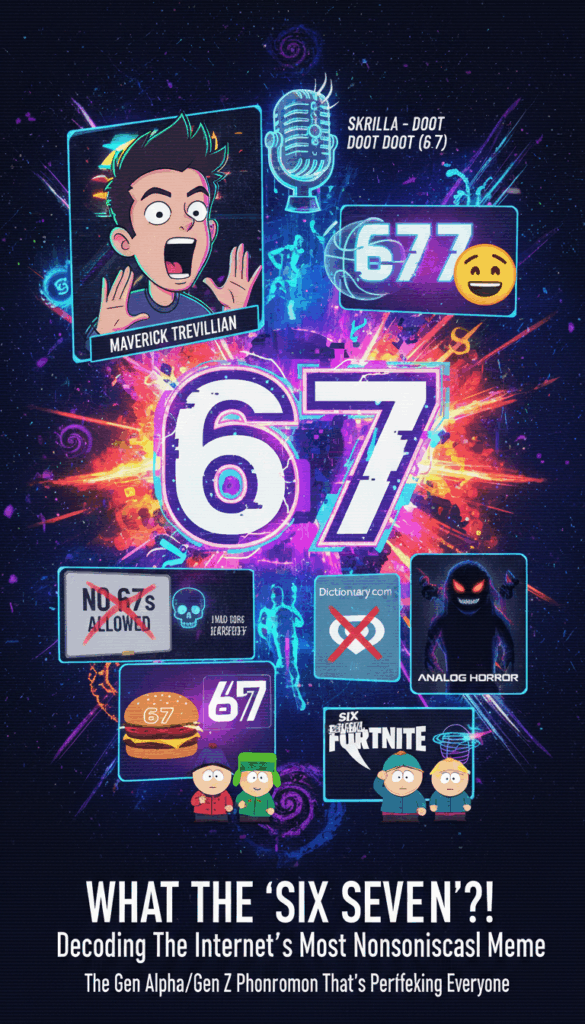
Like a digital Big Bang, it all started with Skrilla’s drill rap track « Doot Doot (6 7) » – that one lyric: « …6-7, I just bipped right on the highway. » A rather unremarkable line, one might think, destined to be lost in the sea of ephemeral internet content. But fate, or rather, the fickle algorithms of social media, had other plans. Skrilla himself admits he never meant anything specific by it. It was simply a line that fit, a rhythmic element in a larger composition.
Theories abounded, of course. Was it a reference to 67th Street? A cryptic police code, perhaps the dreaded 10-67, signaling death? The internet detectives put on their deerstalker hats, only to largely come up empty. The truth, it seemed, was far less sensational.
However, the meme’s ascension wasn’t solely reliant on lyrical ambiguity. The world of sports, with its highlight reels and fervent fanbase, played a crucial role. NBA star LaMelo Ball (who is 6’7″, coincidentally) and high school phenom Taylen « TK » Kinney (« Mr. 6-7 ») became unwitting icons. Basketball edits, peppered with « Six Seven, » began circulating, further embedding the phrase in the digital lexicon. And then, the catalyst. The legendary « 67 Kid » (Maverick Trevillian) and his iconic, enthusiastic shout-out at a basketball game. You know the one – that unbridled enthusiasm, captured in a fleeting moment of viral glory.
III. The Art of Meaninglessness: Why « Six Seven » Works
So, what’s the appeal? Why has this seemingly random combination of digits captured the imagination of the younger generation? The answer, perhaps frustratingly, lies in its very lack of meaning. For Gen Alpha and Gen Z, its deliberate ambiguity is the core appeal. It’s an inside joke, a playful interjection, a « number that is fun to say, » as some have put it. It’s the internet equivalent of Dadaism, a rejection of established norms in favor of the absurd.
Often accompanied by that distinct up-and-down hand motion, « Six Seven » functions as a secret handshake, a visual and auditory cue that signals belonging. It’s a way of saying, « I’m in on the joke. I understand the cultural currents. » Some even see it as a « wholesome replacement » for the much naughtier « 69, » making it classroom-friendly (sort of). « Six Seven » becomes social currency, a digital marker that differentiates the « insiders » from the utterly baffled « outsiders » – that’s you, probably.
IV. The Great Generational Divide: Brain Rot vs. Brilliance?
The chasm between those who « get it » and those who don’t is vast and, at times, seemingly unbridgeable. Kids get it (and love it). For them, it’s shared code, innocent rebellion, and pure fun. Adults don’t (and are often annoyed by it). Parents and teachers are left scratching their heads, often finding the incessant repetition « maddening. » Is this a sign of the impending apocalypse? Probably not.
Many older generations dismiss it as « brain rot » culture – low-quality, nonsensical content that contributes to the perceived dumbing down of society. It’s a classic example of the ever-widening humor gap, a reminder that what one generation finds hilarious, another finds utterly incomprehensible. Is it brain rot, or is it a new form of digital expression that we simply haven’t learned to decode yet?
V. Six Seven Strikes Back: Controversies and Consequences
The seemingly innocuous meme has, inevitably, encountered its share of turbulence. Teachers are reporting massive disruptions – students shouting « Six Seven! » whenever the numbers appear, turning classrooms into digital echo chambers. Schools are banning it, but experts warn that might just make it cooler, driving its appeal underground and amplifying its rebellious allure.
Perhaps more unsettling is the meme’s darker evolution. The innocent « 67 Kid » is now being reimagined as an « analog horror icon » or « Lovecraftian entity » in bizarre online edits – a weird twist for such a seemingly silly meme. The internet, as always, finds a way to corrupt even the most innocent of phenomena. Then there’s the In-N-Out Incident: reports of the fast-food chain removing order #67 because teens kept yelling the meme. Serious dedication (and annoyance!).
VI. The Unstoppable Six Seven: Cultural Impact and Future Vibes
Love it or hate it, « Six Seven » has undeniably left its mark on the cultural landscape of 2025. Dictionary.com crowned « 67 » their 2025 Word of the Year, defining it as a « burst of energy that connects people. » Merriam-Webster also chimed in, acknowledging its widespread usage and cultural significance.
The meme even made it into a South Park episode – you know it’s hit peak cultural penetration when that happens. Brands are clamoring for a piece of the action. From Pizza Hut and McDonald’s to Clash Royale, Overwatch 2, and Fortnite, everyone wants a piece of the « six seven » pie, attempting to leverage its virality to connect with younger audiences. This meme is definitive proof of Generation Alpha’s growing influence on internet trends and the constantly evolving landscape of digital communication. They are the new tastemakers, the arbiters of cool, and « Six Seven » is their anthem.
VII. Conclusion: Six Seven Forever (or at least for now)
A silly phrase, a global phenomenon, and a stark reminder of the generational gap. « Six Seven » is more than just numbers – it’s a cultural marker of 2025, a snapshot of a specific moment in internet history. It’s a reminder that language is fluid, meaning is subjective, and the internet is a playground for the absurd.
So next time you hear it, maybe try to understand the chaos, or just shrug and shout « Six Seven! » back. Who knows, you might even get a laugh. Or, at the very least, you’ll be able to participate in the conversation, even if you don’t quite understand what you’re saying. And in the age of the internet, that’s often enough.